Scanpy end-to-end
QC filtering, normalization, HVG selection, PCA, Leiden clustering, UMAP, marker genes.
Every protocol encodes real-world best practices — conda environments, tool versions, QC gates, SLURM resource hints — so Claude doesn't guess. Pick one to start, generate a new one, or describe your own.
QC filtering, normalization, HVG selection, PCA, Leiden clustering, UMAP, marker genes.
Multi-dataset harmonization with SCTransform and Harmony — batch correction done right.
Automated annotation with CellTypist + manual marker review in a reproducible notebook.
Dynamical and stochastic velocity models with arrow overlays on your UMAP.
Scrublet on each sample separately, with automatic threshold selection and QC plots.
Ligand-receptor inference across cell types, with circos and heatmap visualizations.
Count modelling with shrinkage, LFC estimates, dispersion plots, and volcano output.
Pure-Python DESeq2 reimplementation — perfect for HPC where R envs are painful.
Two-pass STAR alignment plus Salmon quant with decoy-aware index, wrapped in Snakemake.
Pre-ranked GSEA with MSigDB hallmark, C5, and custom gene sets. Tidy tables + plots.
Space Ranger outputs → Scanpy/Seurat spatial object → spot clustering and niches.
Reference scRNA → spatial cell-type abundance maps with Bayesian uncertainty.
Subcellular-resolution ingestion, cell-boundary QC, and spatial neighborhood analysis.
Cell-boundary masks with Cyto, Nuclei, or custom-trained models; GPU-aware.
Shape-aware star-convex polygon detection for dense nuclei in IF / IHC / DAPI.
Whole-tissue Mesmer segmentation for multiplexed IF (CODEX, MIBI, IMC).
Trim, align with bowtie2, call peaks with MACS2, annotate, and compute FRiP / TSS.
Broad or narrow peak calling with MACS2; deepTools bigWig QC; motif enrichment.
Low-input chromatin profiling with SEACR peak calling and spike-in normalization.
Tile matrix, gene-score inference, peak-to-gene linkage, and motif footprinting.
TF-binding-site enrichment in peak sets with JASPAR PFMs + HOMER backups.
Fetch predicted structure by UniProt ID, visualize pLDDT, align homologs.
Batch structural rendering with publication-ready ray-traced images.
FASTA/PDB parsing, BLAST, multiple-sequence alignment, phylogeny helpers.
Search NCBI E-utilities, retrieve abstracts, cite DOIs inline during chat sessions.
Query GSE / GSM accessions, pull metadata, stream count matrices to disk.
Tissue-specific gene expression and eQTL lookup across the GTEx v8 release.
Pathway enrichment and gene-ontology crosswalks — human, mouse, more.
Cross-species ortholog lookup, Ensembl ↔ RefSeq ↔ HGNC resolution.
Submit and track workflows on Latch's cloud-native bioinformatics platform.
Publication-ready volcano plots with labeled hits, thresholds, and custom styling.
Tune n_neighbors, min_dist, and seed for reproducible embeddings.
Lab-branded style sheets for consistent figures across manuscripts and grants.
Multi-annotation heatmaps with dendrograms, splits, and composite color bars.
Fine-tune or run inference with Geneformer, scGPT, and other biology-domain LLMs.
Latent-space modelling for batch correction, differential expression, and imputation.
GPU-aware templates — DataLoader, mixed precision, checkpointing, W&B logging.
Don't see what you need? Ask the agent — it can write any protocol on demand.
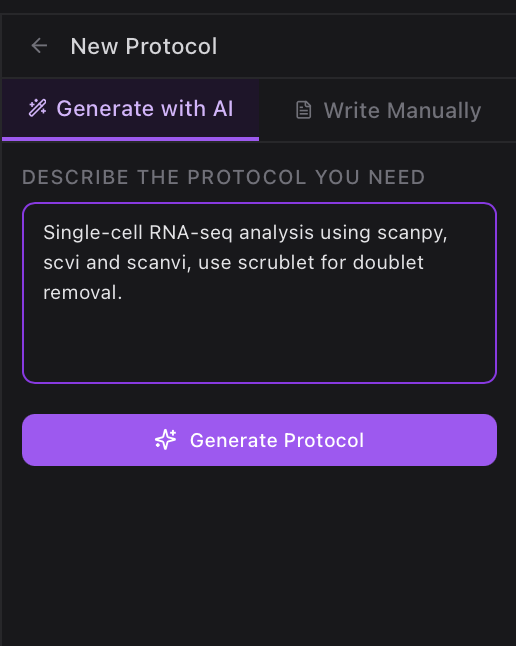
Describe the workflow you need — "cross-species single-cell integration with batch correction and SCENIC TF inference" — and Operon writes the full protocol: tool choices, parameters, conda env, QC gates, and output plots.